7.3 Coolant Flow
Fragment manuala — str. 363
📋 Tekst do skopiowania (OCR/wyszukiwanie)
COOLANT FLOW                                                                                                                      7.3
OPERATION                                                         Coolant Overflow Tank
                                                                  1.        As temperature increases in the cooling system, so does
Engine Below Operating Temperature                                          pressure. To control pressure, the pressure cap (2) allows
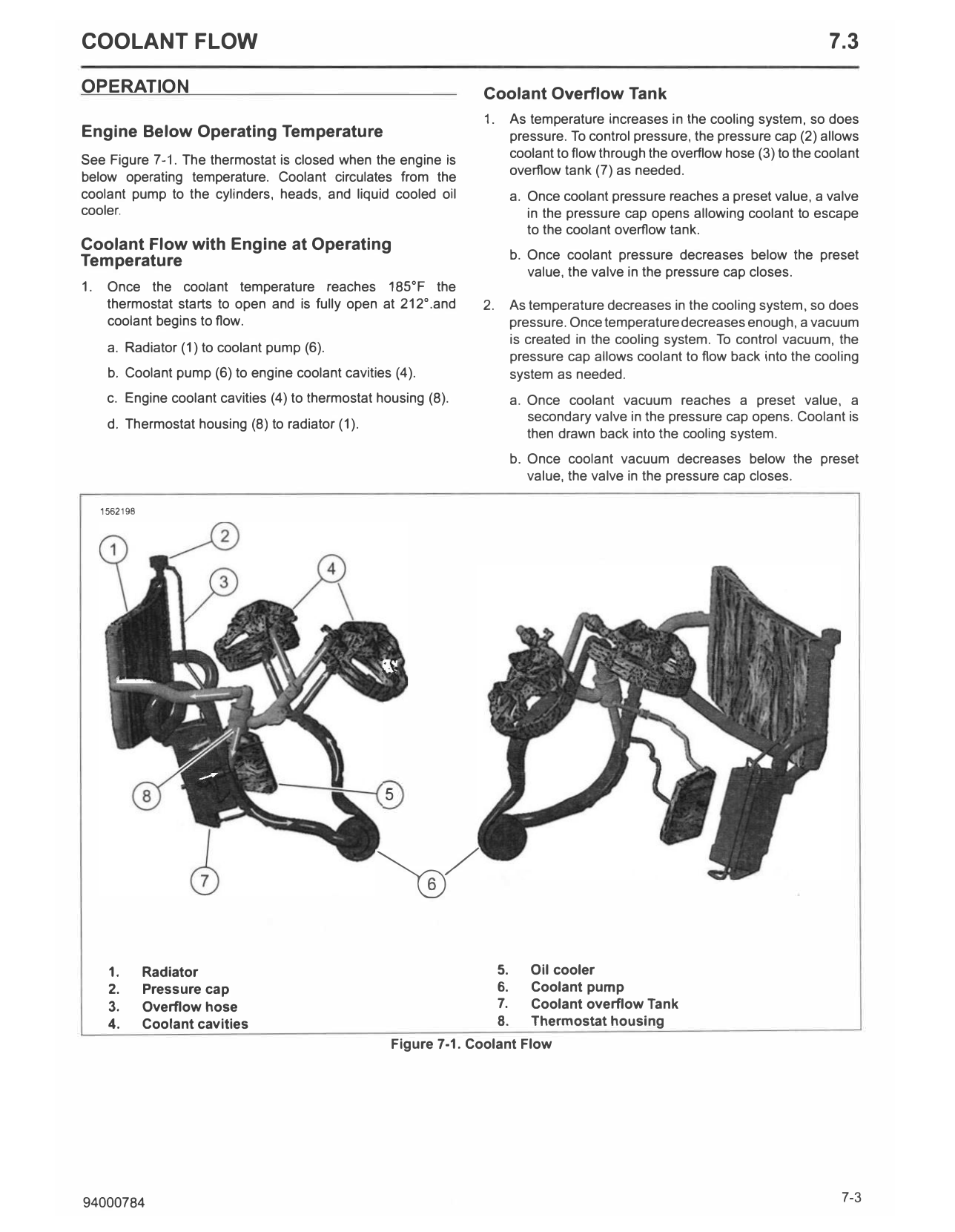
See Figure 7-1. T he thermostat is closed when the engine is                coolant to flow through the overflow hose (3) to the coolant
below operating temperature. Coolant circulates from the                    overflow tank (7) as needed.
coolant pump to the cylinders, heads, and liquid cooled oil                 a. Once coolant pressure reaches a preset value, a valve
cooler.                                                                        in the pressure cap opens allowing coolant to escape
                                                                               to the coolant overflow tank.
Coolant Flow with Engine at Operating
                                                                            b. Once coolant pressure decreases below the preset
Temperature
                                                                               value, the valve in the pressure cap closes.
1.    Once the coolant temperature reaches 185 ° F the
      thermostat starts to open and is fully open at 212° .and    2.        As temperature decreases in the cooling system, so does
      coolant begins to flow.                                               pressure. Once temperature decreases enough, a vacuum
                                                                            is created in the cooling system. To control vacuum, the
      a. Radiator (1) to coolant pump (6).
                                                                            pressure cap allows coolant to flow back into the cooling
      b. Coolant pump (6) to engine coolant cavities (4).                   system as needed.
      c. Engine coolant cavities (4) to thermostat housing (8).             a. Once coolant vacuum reaches a preset value, a
      d. T hermostat housing (8) to radiator (1).                              secondary valve in the pressure cap opens. Coolant is
                                                                               then drawn back into the cooling system.
                                                                            b. Once coolant vacuum decreases below the preset
                                                                               value, the valve in the pressure cap closes.

     1562198

                                                    5

                                                    V
      1.       Radiator                                                5.      Oil cooler
      2.       Pressure cap                                            6.      Coolant pump
      3.       Overflow hose                                           7.      Coolant overflow Tank
      4.       Coolant cavities                                        8.      Thermostat housing
                                                     Figure 7-1. Coolant Flow

94000784                                                                                                                            7-3