2.6 Inspect Tires And Wheels
Fragment manuala — str. 39–41
📋 Tekst do skopiowania (OCR/wyszukiwanie)
INSPECT TIRES AND WHEELS 2.6
GENERAL TIRES
A WARNING Tire Pressure
Match tires, tubes, rim strips or seals, air valves and caps A WARNING
to the correct wheel. Contact a Harley-Davidson dealer.
Mismatching can lead to tire damage, allow tire slippage Be sure tires are properly inflated, balanced, undamaged,
on the wheel or cause tire failure, which could result in and have adequate tread. Inspect your tires regularly and
death or serious injury. (00023c) see a Harley-Davidson dealer for replacements. Riding
with excessively worn, unbalanced, improperly inflated,
A WARNING overloaded or damaged tires can lead to tire failure and
adversely affect stability and handling, which could result
Harley-Davidson front and rear tires are not the same.
in death or serious injury. (00014b)
Interchanging front and rear tires can cause tire failure,
which could result in death or serious injury. (00026a)
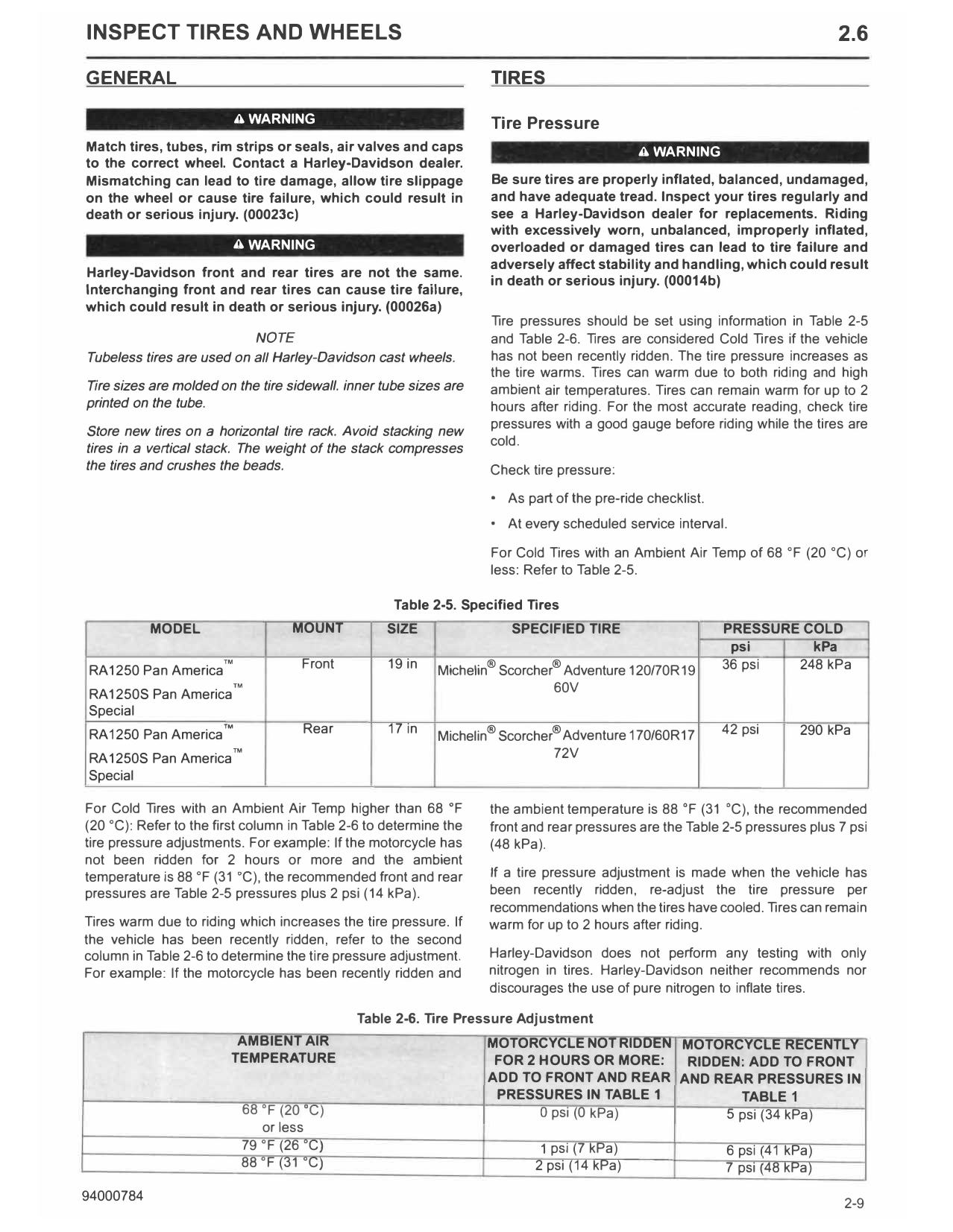
Tire pressures should be set using information in Table 2-5
NOTE and Table 2-6. Tires are considered Cold Tires if the vehicle
Tubeless tires are used on all Harley-Davidson cast wheels. has not been recently ridden. The tire pressure increases as
the tire warms. Tires can warm due to both riding and high
Tire sizes are molded on the tire sidewall. inner tube sizes are ambient air temperatures. Tires can remain warm for up to 2
printed on the tube. hours after riding. For the most accurate reading, check tire
Store new tires on a horizontal tire rack. Avoid stacking new pressures with a good gauge before riding while the tires are
cold.
tires in a vertical stack. The weight of the stack compresses
the tires and crushes the beads. Check tire pressure:
• As part of the pre-ride checklist.
• At every scheduled service interval.
For Cold Tires with an Ambient Air Temp of 68 °F (20 °C) or
less: Refer to Table 2-5.
Table 2-5. Specified Tires
MODEL MOUNT SIZE SPECIFIED TIRE PRESSURE COLD
psi kPa
RA1250 Pan America
TM
Front 19 in ® ®
Michelin Scorcher Adventure 120/70R19 36 psi 248 kPa
RA1250S Pan America
TM
60V
Special
RA1250 Pan America
TM
Rear 17 in ® ® 42 psi 290 kPa
Michelin Scorcher Adventure 170/60R17
RA1250S Pan America
TM
72V
Special
For Cold Tires with an Ambient Air Temp higher than 68 °F the ambient temperature is 88 °F (31 °C), the recommended
(20 °C): Refer to the first column in Table 2-6 to determine the front and rear pressures are the Table 2-5 pressures plus 7 psi
tire pressure adjustments. For example: If the motorcycle has (48 kPa).
not been ridden for 2 hours or more and the ambient
temperature is 88 °F (31 °C), the recommended front and rear If a tire pressure adjustment is made when the vehicle has
pressures are Table 2-5 pressures plus 2 psi (14 kPa). been recently ridden, re-adjust the tire pressure per
recommendations when the tires have cooled. Tires can remain
Tires warm due to riding which increases the tire pressure. If warm for up to 2 hours after riding.
the vehicle has been recently ridden, refer to the second
column in Table 2-6 to determine the tire pressure adjustment. Harley-Davidson does not perform any testing with only
For example: If the motorcycle has been recently ridden and nitrogen in tires. Harley-Davidson neither recommends nor
discourages the use of pure nitrogen to inflate tires.
Table 2-6. Tire Pressure Adjustment
AMBIENT AIR MOTORCYCLE NOT RIDDEN MOTORCYCLE RECENTLY
TEMPERATURE FOR 2 HOURS OR MORE: RIDDEN: ADD TO FRONT
ADD TO FRONT AND REAR AND REAR PRESSURES IN
PRESSURES IN TABLE 1 TABLE 1
68 °F (20 °C) O psi (0 kPa) 5 psi (34 kPa)
or less
79 °F (26 °C) 1 psi (7 kPa) 6 psi (41 kPa)
88 °F (31 °C) 2 psi (14 kPa) 7 psi (48 kPa)
Table 2-6. Tire Pressure Adjustment
AMBIENT AIR MOTORCYCLE NOT RIDDEN MOTORCYCLE RECENTLY
TEMPERATURE FOR 2 HOURS OR MORE: RIDDEN: ADD TO FRONT
ADD TO FRONT AND REAR AND REAR PRESSURES IN
PRESSURES IN TABLE 1 TABLE 1
99 °F (37 °C) 3 psi (21 kPa) 8 psi (55 kPa)
108 °F (42 °C) 4 psi (28 kPa) 9 psi (62 kPa)
or higher
Inspecting Tires TIRE REPLACEMENT
A WARNING
A WARNING
Replace tire immediately with a Harley-Davidson specified
tire when wear bars become visible or only 1/32 in (1 mm) Tires are a critical safety component. Contact a
tread depth remains. Riding with a worn tire could result Harley-Davidson dealer for tire repair or replacement.
in death or serious injury. (00090c) Improper tire service can adversely affect stability and
handling, which could result in death or serious injury.
(00057a)
Check tire tread:
• As part of the pre-ride checklist. A WARNING
• At every scheduled service interval. Harley-Davidson recommends the use of its specified tires.
Harley-Davidson vehicles are not designed for operation
1. Inspect each tire for punctures, cuts and breaks. with non-specified tires, including snow, moped and other
special-use tires. Use of non-specified tires can adversely
Harley-Davidson tires are equipped with wear bars that run affect stability, handling or braking and lead to loss of
horizontally across the tread. vehicle control, which could result in death or serious
injury. (00024d)
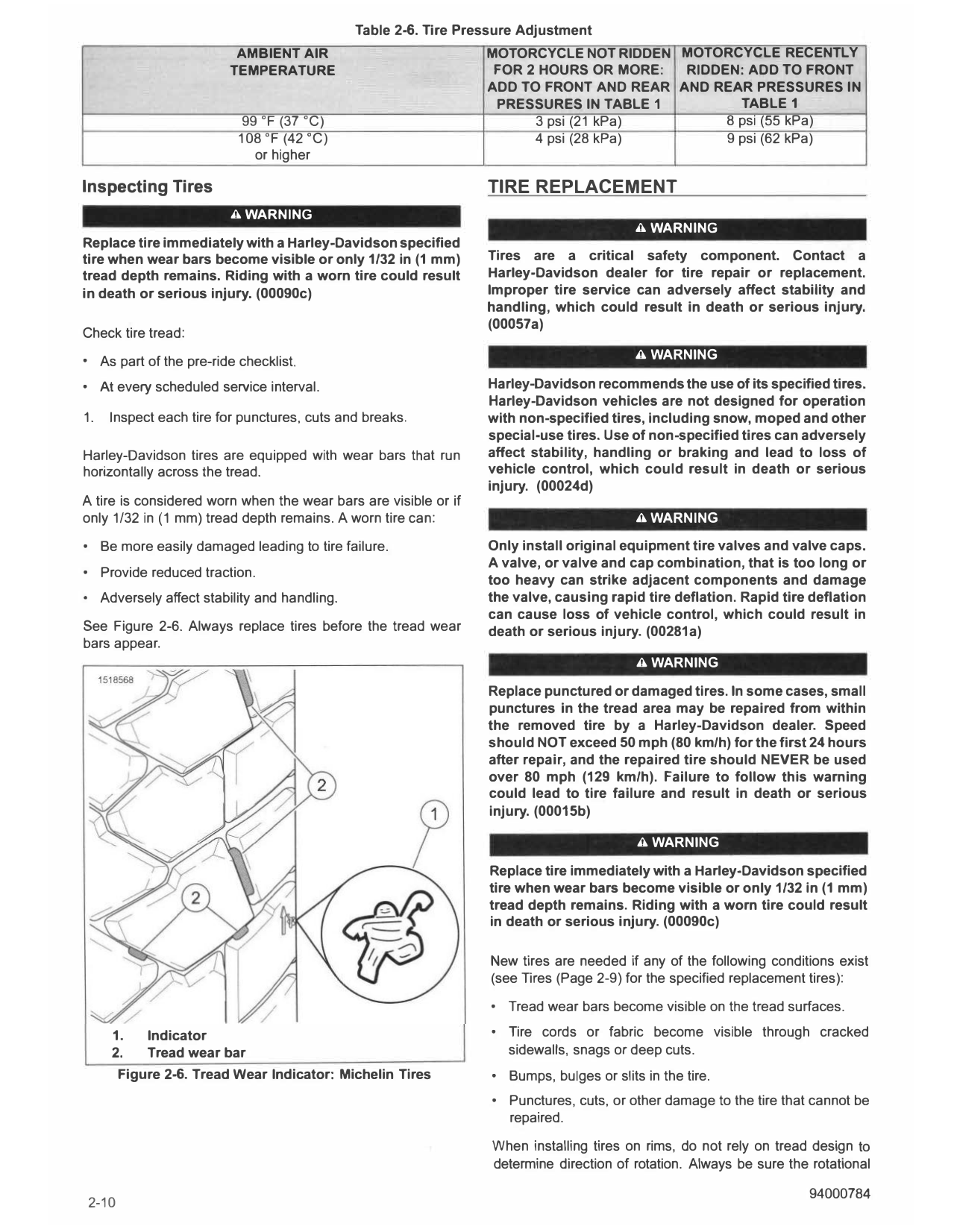
A tire is considered worn when the wear bars are visible or if
only 1/32 in (1 mm) tread depth remains. A worn tire can: A WARNING
• Be more easily damaged leading to tire failure. Only install original equipment tire valves and valve caps.
A valve, or valve and cap combination, that is too long or
• Provide reduced traction.
too heavy can strike adjacent components and damage
• Adversely affect stability and handling. the valve, causing rapid tire deflation. Rapid tire deflation
can cause loss of vehicle control, which could result in
See Figure 2-6. Always replace tires before the tread wear death or serious injury. (00281a)
bars appear.
A WARNING
Replace punctured or damaged tires. In some cases, small
punctures in the tread area may be repaired from within
the removed tire by a Harley-Davidson dealer. Speed
should NOT exceed 50 mph (80 km/h) for the first 24 hours
after repair, and the repaired tire should NEVER be used
over 80 mph (129 km/h). Failure to follow this warning
could lead to tire failure and result in death or serious
injury. (00015b)
A WARNING
Replace tire immediately with a Harley-Davidson specified
tire when wear bars become visible or only 1/32 in (1 mm)
tread depth remains. Riding with a worn tire could result
in death or serious injury. (00090c)
New tires are needed if any of the following conditions exist
(see Tires (Page 2-9) for the specified replacement tires):
• Tread wear bars become visible on the tread surfaces.
1. Indicator • Tire cords or fabric become visible through cracked
2. Tread wear bar sidewalls, snags or deep cuts.
Figure 2-6. Tread W ear Indicator: Michelin Tires • Bumps, bulges or slits in the tire.
• Punctures, cuts, or other damage to the tire that cannot be
repaired.
When installing tires on rims, do not rely on tread design to
determine direction of rotation. Always be sure the rotational
arrows molded into the sidewalls point in the direction of 5. If damaged spokes are found replace. See WHEEL
rotation when the vehicle is moving forward. LACING (Page 3-14).
WHEEL BEARINGS NOTE
• If more than 5 consecutive spokes are loose or damaged,
NOTE replace wheel.
Replace bearings in sets only See SEALED WHEEL
BEARINGS (Page 3-19). Adjust Wheel Spoke
1. Replace when bearings exceed end play service wear limit NOTE
of Do not remove spoke nut from spoke.
0.002 in (0.051 mm)
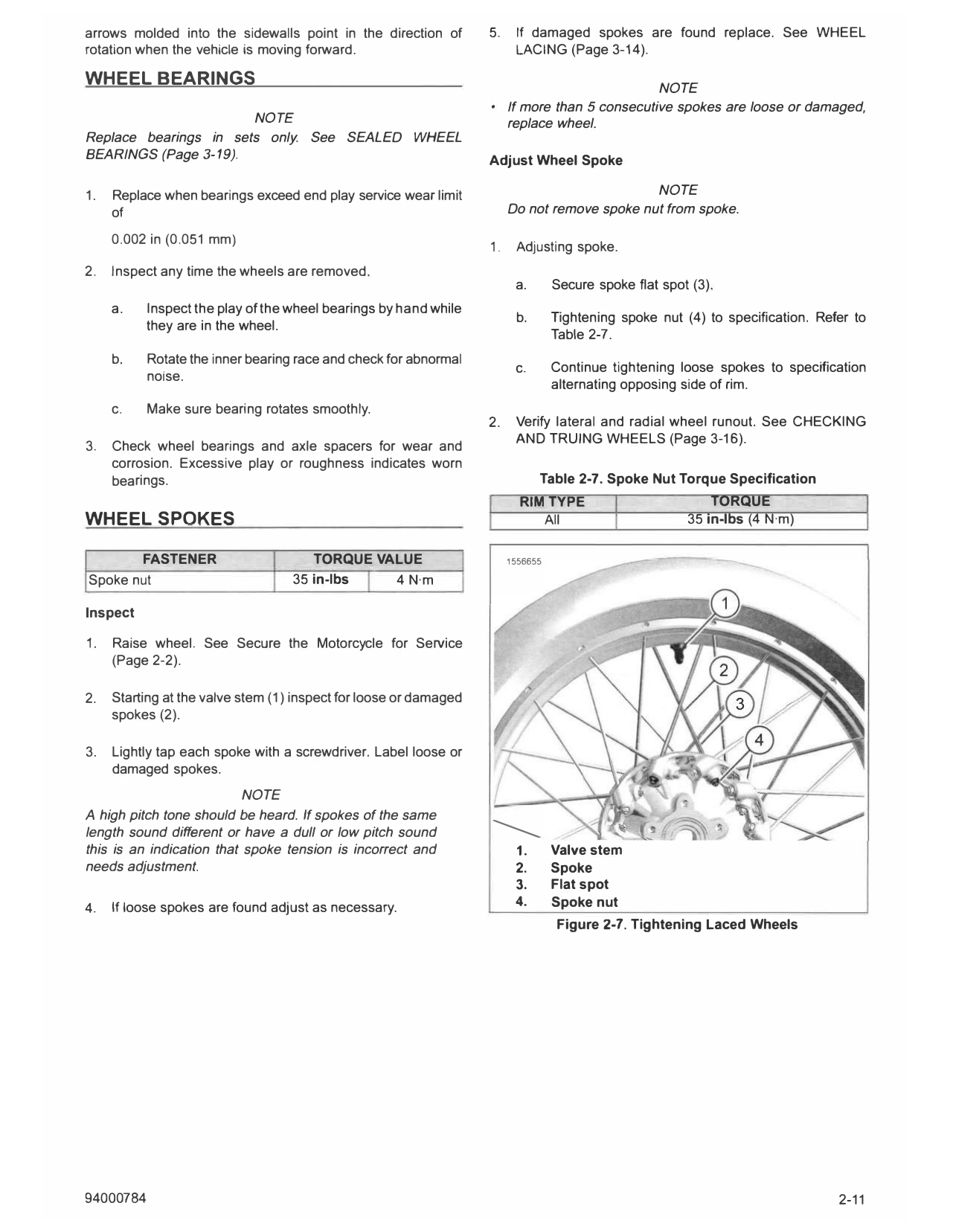
1. Adjusting spoke.
2. Inspect any time the wheels are removed.
a. Secure spoke flat spot (3).
a. Inspect the play of the wheel bearings by hand while
b. Tightening spoke nut (4) to specification. Refer to
they are in the wheel.
Table 2-7.
b. Rotate the inner bearing race and check for abnormal
c. Continue tightening loose spokes to specification
noise.
alternating opposing side of rim.
c. Make sure bearing rotates smoothly.
2. Verify lateral and radial wheel runout. See CHECKING
AND TRUING WHEELS (Page 3-16).
3. Check wheel bearings and axle spacers for wear and
corrosion. Excessive play or roughness indicates worn
bearings. Table 2-7. Spoke Nut Torque Specification
RIM TYPE TORQUE
WHEEL SPOKES All 35 in-lbs (4 N·m)
FASTENER TORQUE VALUE 1556655
Spoke nut 35 in-lbs 4 N·m
Inspect
1. Raise wheel. See Secure the Motorcycle for Service
(Page 2-2).
2. Starting at the valve stem ( 1) inspect for loose or damaged
spokes (2).
3. Lightly tap each spoke with a screwdriver. Label loose or
damaged spokes.
----
NOTE
A high pitch tone should be heard. If spokes of the same
length sound different or have a dull or low pitch sound
this is an indication that spoke tension is incorrect and 1. Valve stem
needs adjustment. 2. Spoke
3. Flat spot
4. If loose spokes are found adjust as necessary. 4. Spoke nut
Figure 2-7. Tightening Laced Wheels
94000784 2-11