4.6 Camshaft And Phaser Operation
Fragment manuala — str. 214
📋 Tekst do skopiowania (OCR/wyszukiwanie)
CAMSHAFT AND PHASER OPERATION                                                                                                4.6

OPERATION                                                           See Figure 4-10. The VVT uses Cam Torque Actuation (CTA)
                                                                    to adjust valve timing. The valve spring force on the cam lobes
The engine uses Variable Valve Timing (VVT) to reduce               adjusts the cam's advancement depending on whether it is
compromises between peak power, bottom end torque, fuel             going up the cam lobe (less advance) or coming down the lobe
economy, emissions and run quality. VVT controls and varies         (more advance). CTA phasers require less oil pressure versus
the timing of the valves opening and closing to accommodate         traditional hydraulic phasers.
a wide RPM range.
                                                                    The VVT system uses oil from the lubrication system to adjust
The Electronic Control Module (ECM) monitors a variety of           valve timing as needed. The spool valve allows oil to flow into
parameters to make valve timing adjustments including:              the housing chambers creating a hydraulic lock on cam rotation.
                                                                    Using WT to advance the exhaust cams and retard the intake
• Camshaft position                                                 cams, reduces compression eliminating the need for ACR
• Throttle position                                                 solenoids during start-up.

• Engine temperature                                                  1591267

• Engine load
• RPM

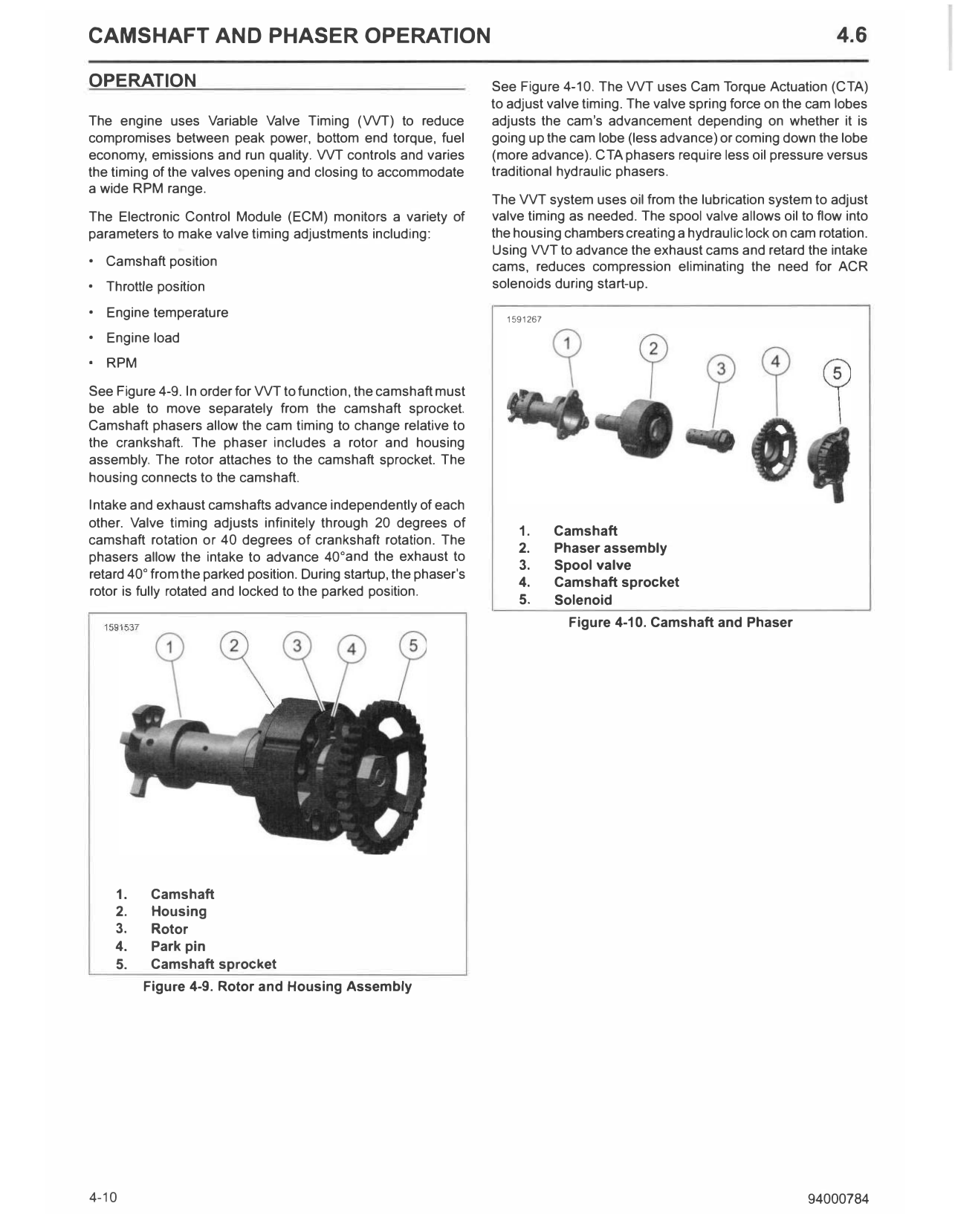
See Figure 4-9. In order for VVT to function, the camshaft must
be able to move separately from the camshaft sprocket.
Camshaft phasers allow the cam timing to change relative to
the crankshaft. The phaser includes a rotor and housing
assembly. The rotor attaches to the camshaft sprocket. The
housing connects to the camshaft.

Intake and exhaust camshafts advance independently of each
other. Valve timing adjusts infinitely through 20 degrees of
                                                                        1.      Camshaft
camshaft rotation or 40 degrees of crankshaft rotation. The
                                                                        2.      Phaser assembly
phasers allow the intake to advance 40° and the exhaust to
                                                                        3.      Spool valve
retard 40° from the parked position. During startup, the phaser's
                                                                        4.      Camshaft sprocket
rotor is fully rotated and locked to the parked position.
                                                                        5.      Solenoid
                                                                                  Figure 4-10. Camshaft and Phaser

    1.    Camshaft
    2.    Housing
    3.    Rotor
    4.    Park pin
    5.    Camshaft sprocket
         Figure 4-9. Rotor and Housing Assembly

4-10                                                                                                                    94000784